
Benefits of Digital Marketing for Hotels – 8 Ways to Drive More Bookings

By: Frank DePino | September 3, 2026


Loading the Elevenlabs Text to Speech AudioNative Player...
The benefits of digital marketing for hotels go far beyond website traffic. Digital channels help hotels reach travelers during trip planning, generate more direct bookings, reduce dependence on third-party platforms, build stronger guest relationships, and connect marketing activity to booking revenue.
Travelers may discover a destination through social media, compare hotels on Google, read reviews, check rates on a metasearch platform, visit an OTA, and finally book through a hotel’s website.
A strong digital presence gives hotels opportunities to appear throughout that journey.
Key takeaways:
- Digital marketing helps hotels reach travelers across search, Maps, metasearch, social media, and AI-powered discovery.
- Strong direct channels can increase reservations through the hotel’s own website.
- First-party guest data supports more relevant campaigns and repeat bookings.
- Digital campaigns can be measured against bookings, revenue, acquisition cost, and return on ad spend.
- Personalization helps hotels communicate differently with families, business travelers, couples, repeat guests, and other segments.
- A strong digital marketing strategy for hotels connects multiple channels around the same booking goals.
What Are the Benefits of Digital Marketing for Hotels?
The main benefits of digital marketing for hotels include greater visibility, more direct bookings, better audience targeting, access to first-party guest data, measurable performance, personalized guest communication, stronger trust, and greater visibility as travelers begin using AI tools for trip planning.
| Benefit | Impact on Hotels | Key Channels |
| Greater visibility | More travelers discover the property | SEO, Maps, metasearch, social |
| More direct bookings | Less reliance on third-party bookings | Website, PPC, email, metasearch |
| Better targeting | Reach travelers more likely to book | Paid search, social, remarketing |
| First-party data | Better understanding of guest behavior | CRM, booking engine, email |
| Measurable performance | Connect marketing to revenue | Analytics, booking engine, ads |
| Personalization | More relevant guest communication | CRM, email, remarketing |
| Stronger trust | More confidence before booking | Reviews, photography, social |
| AI visibility | Appear in new travel discovery experiences | SEO, GEO, digital PR |

Why Is Digital Marketing Important in the Hotel Industry?
The importance of digital marketing in the hospitality industry comes from how travelers now research and book trips. Guests move between search engines, Google Maps, social media, reviews, metasearch platforms, OTAs, and hotel websites before choosing where to stay.
Expedia Group found that 59% of hotel guests book through a mobile website or app, reinforcing how important a strong digital and mobile presence has become throughout the hotel booking journey.
Digital marketing in the hotel industry gives properties opportunities to influence those decisions while measuring which channels generate traffic, bookings, and revenue. Unlike many traditional channels, hotels can see what is working and adjust their marketing based on actual performance.
For this reason, digital marketing for hospitality is not simply about attracting attention. It helps turn that attention into measurable demand.
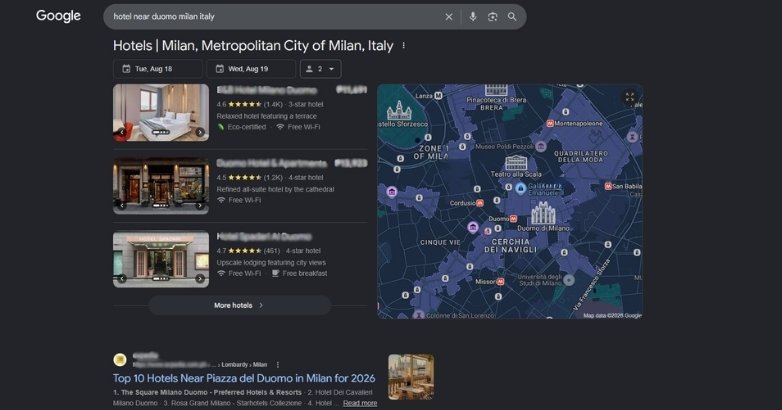
1. Greater Visibility Across Search, Maps, and Metasearch
One of the biggest advantages of digital marketing for hotels is the ability to reach travelers across multiple discovery channels.
A hotel can appear when someone:
- Searches for hotels near a destination or attraction
- Compares properties in Google Maps
- Checks room rates through hotel search and metasearch platforms
- Watches destination content on social media
- Reads a local travel guide
These touchpoints create multiple opportunities to introduce the property before a traveler decides where to book.
Hotel SEO, local landing pages, Google Business Profile, destination content, paid media, digital PR, and social content can all contribute to online visibility.
The goal is no longer simply appearing in a standard Google result. Hotels need to be present across the places travelers use to research and compare accommodations.
Is Your Hotel Showing Up in ChatGPT?
Travelers are increasingly using AI tools to research destinations before they ever reach a booking site. See how your hotel appears in these AI-generated answers, where competitors or OTAs may be gaining visibility, and whether there are opportunities to strengthen your presence.
2. More Direct Bookings and Less Dependence on OTAs
One of the most valuable hotel digital marketing benefits is the ability to send travelers directly to the property’s website and booking engine.
Online travel agencies remain valuable distribution partners, but hotels that rely heavily on them give up some control over the booking relationship and pay third-party distribution costs.
SEO, branded paid search, email marketing, remarketing, direct-booking offers, and metasearch can bring potential guests back to the hotel’s own website.
Google’s hotel search ecosystem also gives properties ways to display rates and direct travelers toward booking providers.
The value of a direct reservation goes beyond distribution costs. When guests book directly, hotels have a stronger opportunity to build the customer relationship before arrival and continue communicating after the stay.
This can support future promotions, loyalty programs, upsells, and repeat bookings.
Elevate Your Hospitality Brand Today
Schedule Your Free Consultation
Seeking to elevate your business? Let Mediaboom guide you. Secure your exclusive, free consultation with our digital marketing experts today.
3. Better Targeting of High-Intent Travelers
Traditional advertising often reaches large audiences regardless of whether they are currently planning a trip.
Digital advertising gives hotels much more control over who sees their campaigns.
Audiences can be based on factors such as:
- Geographic location
- Destination interest
- Previous website visits
- Search behavior
- Guest type
- Past stays
- Abandoned booking sessions
- Interaction with previous campaigns
A resort, for example, does not need to promote the same experience to every traveler.
Families may respond to larger rooms and nearby activities, couples may care more about dining or spa packages, and previous guests may be more interested in a return-stay offer.
Remarketing can also reconnect with travelers who visited the hotel’s website but left before completing a reservation.
Hotels can use the same targeting capabilities to support slower periods with midweek stays, seasonal packages, event-related offers, or last-minute availability.
This makes marketing spend more closely connected to actual booking intent.

4. Access to Valuable First-Party Guest Data
Direct digital relationships give hotels access to information that can help them better understand and communicate with guests.
With appropriate consent and privacy practices, hotels can learn from information such as:
- Booking history
- Email engagement
- Room preferences
- Past offers
- Website behavior
- Previous stays
- Package purchases
- Guest segments
A hotel may identify repeat leisure guests, corporate travelers, families, weekend visitors, event attendees, or past guests who have not returned recently.
That information can support more relevant promotions, loyalty campaigns, upsells, and repeat-booking efforts.
A hotel that builds its own guest database also has a direct way to reconnect with past customers rather than depending entirely on audiences controlled by search engines, social networks, or OTAs.
This makes first-party data increasingly important to digital marketing for the hospitality industry.

5. Marketing Performance Can Be Connected to Revenue
Digital marketing gives hotels far more information about performance than most traditional marketing channels.
Instead of simply asking whether a campaign created awareness, hotel marketers can track outcomes such as:
- Direct bookings
- Booking conversion rate
- Cost per booking
- Direct booking revenue
- Return on ad spend
- Booking engine visits
- Revenue by campaign
- Abandoned booking rate
- Direct booking share
Website analytics, advertising platforms, booking engines, CRM systems, and call tracking can all contribute to this picture.
This allows hotels to compare what they spend with what campaigns actually produce.
If one campaign attracts traffic but few reservations while another generates profitable bookings, budgets can be shifted toward the stronger performer.
Digital marketing therefore gives hotels a clearer connection between marketing activity and revenue rather than relying on impressions, clicks, or followers alone.

6. More Personalized Guest Communication
Another major benefit of digital marketing for hospitality is the ability to communicate differently with different types of guests.
Hotels do not need to send the same message or promotion to everyone in their database.
Campaigns can reflect guest interests, travel history, booking behavior, or stage of the customer journey.
Examples include:
- Pre-arrival information for upcoming guests
- Family packages sent to previous family travelers
- Spa offers for guests who previously booked treatments
- Business packages for corporate travelers
- Return-stay offers for past guests
- Post-stay requests for reviews
- Win-back campaigns for guests who have not returned
Email automation and CRM systems make these campaigns easier to manage across larger guest databases.
The result is communication that is more relevant to the recipient and more closely connected to the guest relationship.
Personalization can also support repeat stays, upgrades, add-on purchases, and loyalty.

7. Stronger Reputation, Trust, and Visual Proof
Travelers often book hotel rooms without seeing the property in person, which makes trust particularly important.
Digital channels allow hotels to reduce uncertainty through reviews, professional photography, guest photos, videos, room information, destination content, and responses to customer feedback.
Hotels can show travelers:
- Rooms and suites
- Amenities
- Restaurants and bars
- Pools and spas
- Nearby attractions
- Guest experiences
- Events
- Seasonal experiences
Reviews add another important layer.
Potential guests can see feedback on Google, OTAs, TripAdvisor, and other platforms while comparing properties.
That feedback can also affect what travelers are willing to pay. Expedia Group’s 2025 Traveler Value Index found that 80% of travelers under 40 are more likely to pay more for a hotel with better reviews.
Hotels that actively monitor reviews, respond professionally, keep information current, and present accurate photos give travelers more reasons to feel confident about booking.
Visual content also helps travelers picture the experience before they arrive.
Photography, video, guest-generated content, and social media therefore do more than build brand awareness. They can directly support the booking decision.
Is Your Hotel Showing Up in ChatGPT?
Travelers are increasingly using AI tools to research destinations before they ever reach a booking site. See how your hotel appears in these AI-generated answers, where competitors or OTAs may be gaining visibility, and whether there are opportunities to strengthen your presence.
8. Greater Visibility in AI and Generative Search
Hotel discovery is beginning to extend beyond traditional search results.
This shift is already visible in traveler behavior. Booking.com’s 2025 Global AI Sentiment Report, based on more than 37,000 consumers across 33 markets, found that 67% had already used AI in some aspect of travel, while 89% said they want to use AI in future travel planning.
Travelers can now ask AI-powered tools highly specific questions about where to stay based on location, amenities, guest type, price range, nearby attractions, and other preferences.
For hotels, that makes clear and detailed online information increasingly important.
Websites should clearly communicate:
- Location
- Amenities
- Room types
- Nearby attractions
- Guest types
- Policies
- Packages
- Distinctive property features
- Frequently asked questions
Search engines and AI systems need enough context to understand when a property matches a traveler’s request.
Hotels should therefore consider whether their website, local profiles, reviews, media coverage, and other online references clearly describe what the property offers.
This approach is often referred to as Generative Engine Optimization, or GEO.
AI discovery is still developing, but it is becoming an important addition to digital marketing for hotels, alongside SEO, local search, metasearch, and other established channels.
What Should a Digital Marketing Strategy for Hotels Focus On?
A digital marketing strategy for hotels should connect the channels involved in discovery, comparison, booking, and retention around measurable business goals.
- Website and booking engine: Make direct reservations simple.
- SEO, local search, and GEO: Build visibility where travelers research accommodations.
- Paid search and metasearch: Reach travelers actively comparing hotels and rates.
- CRM and email: Maintain direct relationships before and after stays.
- Measurement: Track bookings, revenue, conversion rates, and acquisition costs.
Hotels do not need to be active on every channel. The right mix depends on the property’s market, audience, budget, and booking patterns.
Frequently Asked Questions
I. Why is digital marketing important for hotels?
Digital marketing helps hotels reach travelers while they research trips, compare accommodations, and make reservations. It also supports direct bookings, guest relationships, measurable marketing performance, and visibility across search, Maps, metasearch, social platforms, and AI-powered discovery.
II. How does digital marketing increase hotel bookings?
SEO, paid advertising, metasearch, email, social media, remarketing, and destination content can reach travelers at different stages of trip planning. These channels can direct high-intent visitors toward the hotel’s website and booking engine.
III. Can digital marketing reduce hotel dependence on OTAs?
Yes. OTAs remain valuable distribution channels, but SEO, paid search, metasearch, email, loyalty programs, and direct-booking campaigns can increase reservations through a hotel’s own channels.
IV. What are the best digital marketing channels for hotels?
The right mix depends on the property and its guests. For many hotels, the foundation includes a strong website and booking engine, SEO, local search, paid search, metasearch, email, reputation management, and selected social platforms.
V. How can hotels measure digital marketing ROI?
Hotels can track direct booking revenue, cost per booking, booking conversion rate, return on ad spend, direct booking share, and campaign revenue. The goal is to connect marketing activity with reservations and revenue rather than traffic alone.
VI. How is AI changing digital marketing for hotels?
AI-powered search allows travelers to ask more specific questions about destinations and accommodations. Hotels can prepare by publishing clear, factual information about rooms, amenities, location, guest experience, policies, and nearby attractions.
Is Your Hotel Showing Up in ChatGPT?
Travelers are increasingly using AI tools to research destinations before they ever reach a booking site. See how your hotel appears in these AI-generated answers, where competitors or OTAs may be gaining visibility, and whether there are opportunities to strengthen your presence.
Turn Digital Visibility Into More Direct Bookings
The biggest benefits of digital marketing for hotels come from gaining greater control over how travelers discover the property, how they book, and how the relationship continues after their stay.
Search, metasearch, first-party guest data, paid media, email, reviews, social content, and AI discovery each play different roles in that process.
Hotels that build strong direct channels and adapt to changing travel research habits are better positioned to compete for visibility, bookings, and repeat guests.
Mediaboom helps hospitality brands build digital strategies centered on visibility, direct bookings, and measurable growth. Contact our team to discuss how your hotel can turn its digital presence into stronger business results.
WHAT OUR CLIENTS SAY
By: Frank DePino
Frank DePino is the Principal and Founder of Mediaboom, a top hotel marketing agency partnering with leading hotel and hospitality brands. With 30+ years of experience, he has led strategic digital initiatives for names including Four Seasons, Ritz-Carlton, JW Marriott, Millennium Partners, and Guardian Jet. Frank helps hospitality businesses strengthen brand presence, drive qualified leads, and elevate guest experiences through website design, SEO, content marketing, and paid media. Under his leadership, Mediaboom is a trusted partner for brands pursuing measurable digital growth in a competitive hospitality landscape.