Future of Hotel Website Design for High-Converting Hotel Websites

By: Frank DePino | January 23, 2026


The future of hotel website design is built around speed, personalization, automation, and immersive experiences that remove friction and guide travelers toward direct bookings, principles often championed by a hotel marketing agency to maximize conversions.
In 2026, high-performing hotel websites are:
- Instantly fast with sub-second load times
- Mobile-first and thumb-friendly for travelers booking on the go
- AI-powered, delivering personalized offers, room recommendations, and dynamic pricing
- Immersive, using high-quality visuals, video, and interactive content to replace OTAs
- Seamlessly connected to real-time availability, secure payments, and booking engines
- Conversational, allowing guests to search, compare, and book through chat and voice
Rather than acting as a digital brochure, modern hotel websites now function as intelligent booking platforms that increase conversion rates, strengthen brand loyalty, and reflect the strategic design insight a hotel marketing agency brings to digital guest journeys.
In this guide, you’ll discover how modern hotel website design directly impacts conversions, why outdated websites lose bookings to OTAs, and what your hotel must do now to win more direct reservations.
Here’s what we’ll cover:
- Top Benefits of Website Design:
- Core Design Trends Redefining Hotel Websites
- Technology That Drives the Future
- UX Elements That Boost Conversions
- Personalization and Guest-Centric Experiences
- Practical Steps to Future-Proof Your Hotel Website
- Case Studies
- Frequently Asked Questions
- Drive Bookings, Delight Guests
1. Top Benefits of Website Design:
Direct Bookings vs OTA Dependency
Every booking through an OTA costs you 15-25% in commission fees, cutting into profits that could improve your property, reward loyal guests, or grow your marketing budget. But it’s not all about profit. When guests book directly through your site, you gain valuable insights into their preferences and behavior. This gives you the ability to send personalized pre-arrival emails, control post-stay follow-ups, offer tailored upgrades, and take complete ownership of the guest relationship. Hotels that master direct bookings don’t just save on commissions; they build lasting relationships that drive lifetime value.
Your Website as a Digital Lobby
Think of your website as the digital version of your physical lobby. Your actual lobby is likely beautifully designed, welcoming, and easy to navigate, with staff ready to help at every turn. Your website should deliver the same experience. Just as an outdated, confusing lobby erodes trust and creates frustration, so does a poorly designed website.
Rising Guest Expectations
How your website looks and feels matters, but today’s travelers are tech-savvy and have high expectations beyond aesthetics. Such as instant load times (under 3 seconds), intuitive navigation requiring zero learning curve, mobile experiences that rival desktop, personalized content based on their interests, and real-time availability with transparent pricing. If your site doesn’t deliver on these expectations, guests will move on within seconds. The future of hotel website design prioritizes meeting these demands to capture bookings before travelers head to OTAs.
2. Core Design Trends Redefining Hotel Websites
Clean Minimalism and Visual Impact
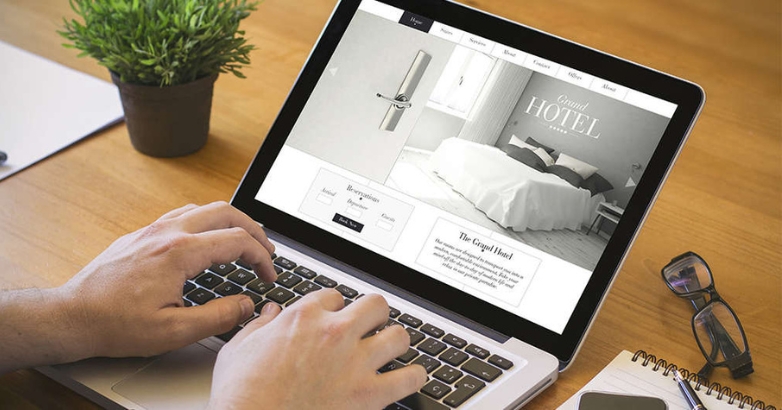
The days of cluttered hotel websites are gone, replaced with modern, minimalist aesthetics. The future of hotel website design embraces strategic whitespace and focused messaging that guides visitors exactly where they need to go. This includes a clear visual hierarchy where booking buttons stand out, strategic whitespace that allows content to breathe, focused messaging with an explicit purpose, and bold typography that grabs attention.
Example: A beachfront hotel features a full-screen hero image of a sunset over the ocean, a simple headline, “Your Coastal Escape Awaits,” and a prominent “Check Availability” button. Nothing competes for attention, creating a clean path to conversion.
High-Quality Imagery and Video Storytelling
Static stock photos on every webpage won’t cut it anymore. Travelers want to see your actual property through authentic, high-quality visuals. Effective content includes:
- Professional photography showing real guests enjoying amenities
- Short video tours (15-30 seconds) highlighting key spaces
- 360-degree room previews
- Drone footage showcasing the location
- Behind-the-scenes content featuring staff
- User-generated content (UGC)
For example, if a ski resort creates an emotional connection with a 20-second video of fresh powder, happy skiers, and a cozy fireplace, it will drive bookings far better than a bulleted list of amenities beneath a stock image.
Mobile-First and Responsive Design
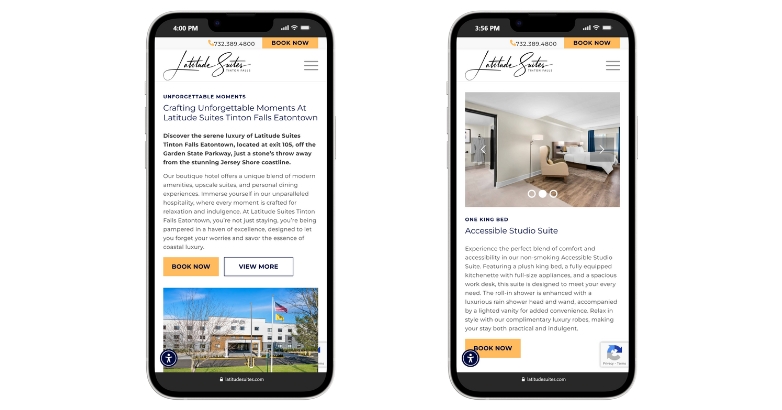
Over 60% of hotel bookings now start on mobile devices. A site that doesn’t work flawlessly on smartphones could cost you more than half of your potential direct bookings, making mobile-first design essential to the future of hotel website design. Your site needs pages that load in under 2 seconds on devices, buttons that are large enough to tap easily, short forms with auto-fill, images that scale perfectly to any screen, and booking flows that require minimal scrolling.
Example: A business traveler in an airport lounge with unexpected plans should be able to book a room on their phone in under 60 seconds.
Story-Driven User Experience
The best hotel websites turn browsing into moments of escape, guiding travelers to imagine the stay and atmosphere in the same way a hotel marketing agency crafts compelling storytelling that engages guests before they even book. They go beyond simply presenting information to tell stories that inspire travelers to actually picture themselves at your property.
To do this, structure your homepage like a journey, not a menu. Use guest testimonials to show real experiences, highlight local attractions and unique experiences, create dedicated landing pages for different traveler types, and connect amenities to emotions and outcomes.
Download Our FREE Guide
Outrank OTAs & Drive Direct Bookings With Our Hospitality Digital Marketing Guide
Learn how leading hotels increase website traffic, reduce OTA commissions, and convert more guests with targeted digital marketing strategies.
3. Technology That Drives the Future
From AI-driven personalization to augmented reality tours and seamless booking, technology is reshaping every step of the traveler’s journey, making hotel websites smarter, faster, and more engaging than ever.
AI and Personalization
The future of hotel website design relies heavily on AI to deliver personalized experiences at scale, including dynamic content that shows visitors from different locations relevant local information, smart recommendations based on browsing behavior and past stays, predictive pricing that shows offers most likely to convert each visitor, and 24/7 chatbot support that answers questions instantly.
Without AI, it’s nearly impossible to so finely tailor your website to each guest so that a family searching for weekend availability sees promotions for your family suite with connecting rooms and pool access, while a solo business traveler is offered executive rooms, conference facilities, and airport shuttle service.
Chatbots and Conversational Interfaces
Similarly, today’s AI-powered chat can provide personalized recommendations, answer complex questions, handle booking modifications, hand off guests to human staff when needed, and operate in multiple languages. Modern hotel chatbots can perform multiple actions quickly and effectively, increasing your conversion rate.
For example, say a couple planning an anniversary trip asks your chatbot, “Do you have rooms with ocean views, and can we arrange a private dinner?” The bot confirms availability, suggests the best room, and connects them with your concierge team, all without leaving the chat.

Voice Search and Advanced Interactions
Optimizing for voice search ensures your hotel can be found and booked with simple spoken requests, which is critical given that smart speakers are now in millions of homes. Ways to ensure optimization include:
- Target conversational keywords (“Where can I stay near downtown Austin with a pool?”)
- Create FAQ pages answering common voice queries
- Ensure your Google Business Profile is complete
- Structure content to appear in featured snippets
- Make booking information easily scannable for voice assistants.
When someone asks their phone, “Find me a pet-friendly hotel near Yellowstone,” your voice-search-optimized website will appear in those results.
AR and VR Experiences
Virtual and augmented reality are moving from gimmicks to genuine conversion tools. Immersive experiences help travelers overcome the fear of booking without physically visiting first. Practical applications include 360-degree virtual room tours that go beyond photos, virtual property walkthroughs of your lobby, pool, and restaurant displaying all amenities, and VR destination previews of nearby attractions.
These features are especially useful for planners who can’t visit in person. A destination wedding planner can virtually walk through your ballroom, terrace, and bridal suite from 2,000 miles away, helping them confidently select your venue over competitors.
Elevate Your Hospitality Brand Today
Schedule Your Free Consultation
Seeking to elevate your business? Let Mediaboom guide you. Secure your exclusive, free consultation with our digital marketing experts today.
Seamless, Secure Booking Engines
All of the website features discussed so far are great, but your booking engine is the moment of truth. The place where a visitor either becomes a guest or clicks away to an OTA. To prevent guests jumping ship, it needs to be fast, easy, secure, and stress-free. Essential features include:
- Real-time availability updates
- Transparent pricing with no hidden fees
- Guest checkout requiring minimal information
- Multiple payment methods (including digital wallets)
- Mobile-optimized forms with auto-fill
- SSL certificates and visible security badges
- Clear cancellation policies
- Progress indicators showing booking steps
4. UX Elements That Boost Conversions
Nevertheless, before a traveler hands over their credit card, they need to feel confident and cared for. The best hotel websites build that trust through clear signals, fast performance, accessibility, and ongoing optimization.
Trust and Social Proof
Effective trust signals include live review feeds from Google and TripAdvisor on your homepage, star ratings and award badges near booking buttons, guest testimonials with photos and names, “Recently booked” notifications showing real-time activity, and industry certifications and safety credentials.
Placing a verified guest testimonial next to your booking form, like “This hotel exceeded every expectation. The rooftop bar alone is worth the stay!”, can solidify trust in your reputation and increase conversions.
Simple Navigation and Accessibility
A potential guest should navigate from your homepage to a booked room in under 2 minutes, regardless of their technical skills or abilities. Best practices include a sticky booking button that follows visitors as they scroll, clear menu labels (avoid creative names that confuse), search functionality for large sites, breadcrumb trails that show the current location, and accessibility features for users of all abilities.
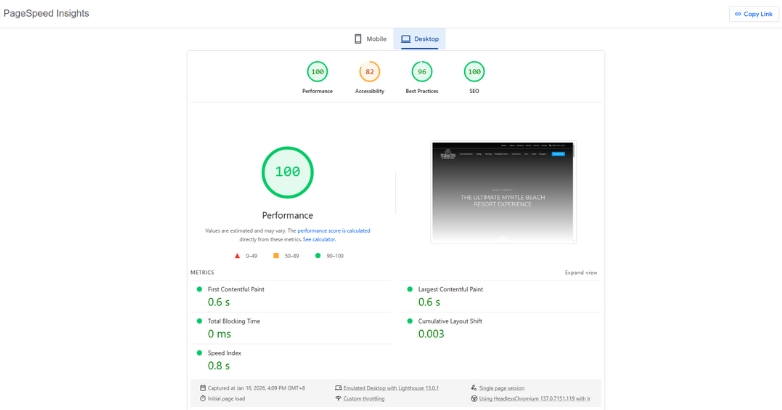
Speed and Technical SEO
Website speed directly impacts both search rankings and conversions. Every additional second of load time can decrease conversions by up to 7%. To optimize your speed, consider compressing and optimizing all images, using a content delivery network (CDN), minimizing JavaScript and CSS files, enabling browser caching, and choosing a fast, reliable hosting provider.
A/B Testing for Performance Optimization
After you’ve implemented all these changes, A/B testing lets you see what really works by comparing two versions and measuring which performs better. Test headline variations (“Book Your Stay” vs “Reserve Your Escape”), call-to-action button colors and placement, hero image choices (property exterior vs interior vs lifestyle), form length and information requested, and pricing display (taxes included vs separate).
For example, changing your primary CTA from “Book Now” to “Check Availability” might increase click-through because it feels less committal.
Ready to exceed guest expectations and boost your website’s conversion rates? Contact Mediaboom a full‑service hotel marketing agency, to get started on creating a high‑performance site that keeps travelers engaged and booking directly.

5. Personalization and Guest-Centric Experiences
Modern websites remember visitors and adapt content to their needs. Loyalty members receive personalized greetings like “Welcome back, Sarah! You have 2,450 points. Book this stay and earn enough for a free night,” with visible benefits, exclusive direct booking rates, and one-click checkout using saved preferences. However, even those who have never stayed with you before should get personalized treatment. A guest who viewed spa packages last month should see spa-related content when they return, not generic homepage information.
That’s because each traveler expects a tailored experience, and UX flows for segmented audiences can help you achieve this. Business travelers can see fast booking options and meeting spaces, families discover kid-friendly amenities and connecting rooms, couples find romantic packages and spa access, while groups access block booking tools and event spaces. Consider having your homepage ask, “What brings you here?” with options for Business, Leisure, Events, or Groups.
The more relevant the experience, the higher your conversion and repeat engagement rates.
Download Our FREE Guide
Outrank OTAs & Drive Direct Bookings With Our Hospitality Digital Marketing Guide
Learn how leading hotels increase website traffic, reduce OTA commissions, and convert more guests with targeted digital marketing strategies.
6. Practical Steps to Future-Proof Your Hotel Website
Step 1: Plan for Periodic Design Refresh Cycles
Your lobby wouldn’t stay the same for years; why should your website? Technology moves fast, and guest expectations evolve constantly. The recommended timeline?
- Minor updates and content refreshes quarterly
- UX improvements and feature additions annually
- Major redesigns every 2-3 years.
Step 2: Embrace Modular and Scalable CMS Platforms
Choosing a content management system (CMS) that can grow with your needs and adapt to new technologies has many benefits. Platforms offering specialized hotel CMS solutions offer flexibility without the need for constant custom development. Look for headless architecture for flexibility, built-in integrations with booking engines and PMS, easy content updates without developer help, multi-property management capabilities, and strong security with regular updates.
Step 3: Integrate Analytics and Conversion Tracking
You can’t improve what you don’t measure. Robust analytics help you understand visitor behavior and identify opportunities. Essential tracking setup includes Google Analytics for comprehensive site metrics, heatmaps showing where users click and scroll, conversion funnels tracking booking completion rates, and A/B testing tools for ongoing optimization. Tactics like these can help you spot trends. So if you notice high traffic but low bookings, you can dig into where users drop off and fix those friction points.
Step 4: Focus on Cross-Device and Accessibility Compliance
Your website needs to work flawlessly across every device and be accessible to all users, including those with varying abilities. Cross-device requirements include responsive design that adapts to any screen size, touch-friendly interfaces for tablets and phones, fast performance on slower connections, and a consistent experience across browsers.
Making your site accessible expands your potential guest pool and can improve search rankings.
7. Case Studies
Marina Inn at Grande Dunes
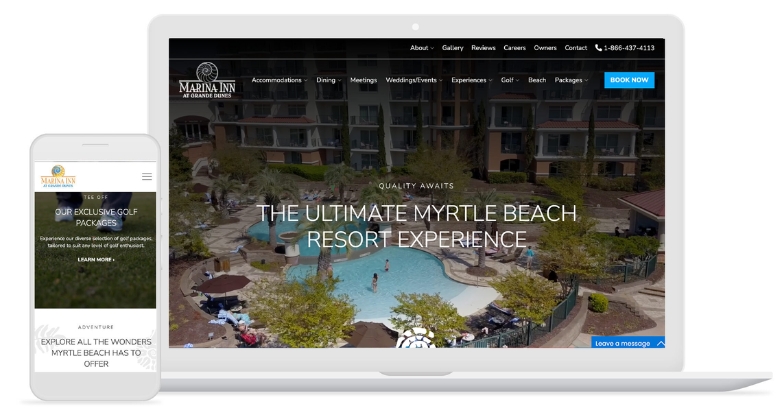
Mediaboom partnered with Marina Inn at Grande Dunes to modernize its website and improve its digital presence, targeting guests seeking a luxurious coastal getaway.
- Website Redesign: We created a mobile-optimized, visually appealing website that highlights Marina Inn’s upscale accommodations, stunning beachfront location, and extensive amenities.
- SEO Strategy: A targeted SEO campaign was launched, focusing on high-conversion keywords like “luxury Myrtle Beach resort” to increase visibility in competitive search markets.
- Content Marketing: Compelling content was developed to showcase the resort’s exceptional guest experiences, including local attractions, dining, and leisure activities.
Results: A 25% increase in organic traffic, improved keyword rankings, and a 20% growth in direct bookings, helping Marina Inn attract more high-value guests.
Millennium Tower San Francisco
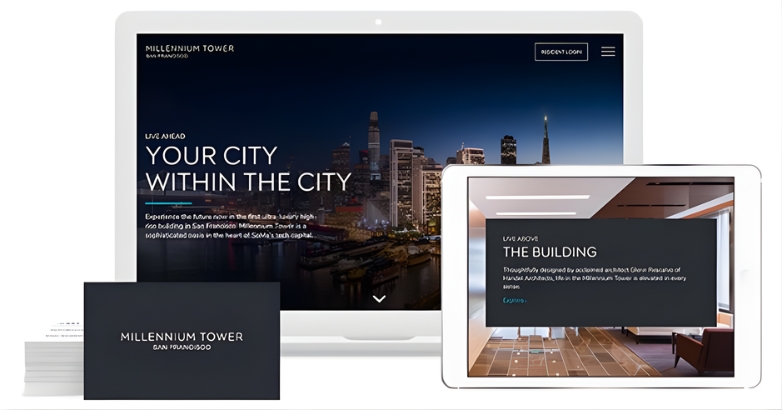
Mediaboom collaborated with Millennium Tower San Francisco to enhance its online presence and drive interest from high-end business travelers and investors.
- Website Redesign: We designed a modern, intuitive, mobile-first website that reflects the luxury and prestige of Millennium Tower, emphasizing its prime location and exclusive residential offerings.
- SEO Strategy: A comprehensive SEO strategy was implemented, focusing on keywords like “luxury real estate San Francisco” to increase the website’s visibility among potential investors and residents.
- Content Marketing: Content was tailored to target high-net-worth individuals with detailed descriptions of the building’s amenities, lifestyle benefits, and investment opportunities.
Results: The website saw a 40% increase in organic search traffic, a notable rise in inquiries from prospective residents, and a higher engagement rate on key landing pages.
Musha Cay
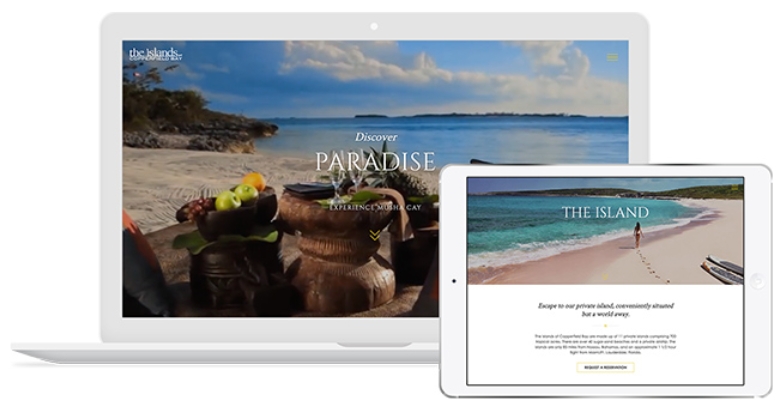
Mediaboom partnered with Musha Cay to enhance its digital footprint and attract high-net-worth travelers seeking exclusive experiences.
- Website Redesign: We developed a visually stunning, mobile-optimized website showcasing the private island’s unique luxury offerings, including bespoke travel experiences and world-class accommodations.
- SEO Strategy: Advanced SEO techniques were implemented to target high-value keywords like “luxury private island getaway,” boosting the site’s visibility for affluent travelers.
- Content Marketing: Compelling content was created to highlight the island’s exclusivity, including rich visuals, immersive descriptions, and client testimonials.
Results: The redesigned website saw a 30% increase in organic traffic, and there was a significant rise in direct inquiries, positioning Musha Cay as a premier luxury destination.
8. Frequently Asked Questions (FAQs)
A well-designed UX enhances satisfaction by making it easy for users to find information, book rooms, and engage with the site. Clear navigation, fast load times, and minimal friction during the booking process ensure that guests feel confident and satisfied, which can lead to higher conversion rates and repeat business.
Accessibility ensures that people with disabilities can access and navigate the hotel website easily. This inclusivity not only improves user experience for all visitors but also helps hotels reach a wider audience, enhance search rankings, and comply with regulations.
AI is transforming hotel website design by offering personalized guest experiences, such as dynamic content, room recommendations, and predictive pricing. It allows hotels to cater to different guest segments with tailored offers and creates a more engaging user experience that can increase conversions and guest satisfaction.
A/B testing allows hoteliers to test different elements of their website, such as call-to-action buttons, headlines, or booking forms, to determine which version performs better. By continuously optimizing based on real data, hotels can improve user experience and increase conversion rates.
Website speed is a crucial factor for both conversions and SEO. A slow-loading website can lead to high bounce rates, lost bookings, and lower search rankings, ultimately reducing the hotel’s visibility. Ensuring fast load times (under 2 seconds) directly enhances both user experience and search engine optimization.
Do You Have More Questions?
If you didn’t find the answers you were looking for, Mediaboom is here to help. Our team of hotel marketing experts is ready to guide you with tailored strategies to achieve your business goals. Reach out to us today, and let’s start a conversation about your hotel’s success.
Elevate Your Hospitality Brand Today
Schedule Your Free Consultation
Seeking to elevate your business? Let Mediaboom guide you. Secure your exclusive, free consultation with our digital marketing experts today.
Drive Bookings, Delight Guests
Your hotel website is more than a digital brochure; it’s a strategic tool that drives direct bookings, strengthens guest relationships, and maximizes revenue. The future of hotel website design demands speed, personalization, transparency, and seamless mobile experiences. Today’s travelers expect these elements as standard, and technologies like AI, AR, and smart booking engines help you deliver them.
Hotels that invest in their digital presence now will stand out in an increasingly competitive market. Ready to build a hotel website that drives more direct bookings and delivers experiences guests remember? Let MediaBoom create the digital foundation your property needs to thrive in 2026 and beyond.
By: Frank DePino
Frank DePino is the Principal and Founder of Mediaboom, a top hotel marketing agency partnering with leading hotel and hospitality brands. With 30+ years of experience, he has led strategic digital initiatives for names including Four Seasons, Ritz-Carlton, JW Marriott, Millennium Partners, and Guardian Jet. Frank helps hospitality businesses strengthen brand presence, drive qualified leads, and elevate guest experiences through website design, SEO, content marketing, and paid media. Under his leadership, Mediaboom is a trusted partner for brands pursuing measurable digital growth in a competitive hospitality landscape.

READY TO IGNITE YOUR MARKETING STRATEGY?


