Hotel Search Engine Marketing – Benefits & Tips for 2026

By: Frank DePino | January 1, 2026


Loading the Elevenlabs Text to Speech AudioNative Player...
In 2026, hotel search engine marketing (SEM) has become more critical than ever, with over 95% of travelers starting their booking journey online, and insights from a hotel marketing agency can help you tailor your SEM strategy for peak performance. Placing your property in front of potential guests at the exact moment they decide where to stay is no longer optional—it’s essential for occupancy and revenue growth.
Hotel SEM leverages paid search ads on Google Hotel Ads, Bing, and other search engines to instantly elevate your property to the top of search results, a tactic often refined with support from a hotel marketing agency. You only pay when a traveler clicks, ensuring every marketing dollar targets guests who are ready to book. With precise audience targeting, strategic keywords, and persuasive ad copy, SEM converts search intent into direct bookings.
This guide will help you harness SEM effectively, covering:
- SEO vs SEM
- 5 Benefits of SEM in the Hospitality Industry
- How to Craft an Effective Hotel SEM Strategy in 5 Steps
- Tips for Managing Your Hotel SEM Campaign
- Case Studies
Is Your Hotel Showing Up in ChatGPT?
Travelers are increasingly using AI tools to research destinations before they ever reach a booking site. See how your hotel appears in these AI-generated answers, where competitors or OTAs may be gaining visibility, and whether there are opportunities to strengthen your presence.
SEO vs SEM
Choosing between SEO and SEM comes down to earning clicks versus buying them. SEO improves your website’s content, speed, and authority to climb organic rankings over time, while SEM uses paid ads to secure instant visibility at the top of search results.
- Speed: SEM delivers results within hours; SEO builds momentum over weeks or months.
- Cost model: SEO requires ongoing time and expertise, whereas SEM charges per click, giving precise budget control.
- Perception: Many travelers trust organic listings more, but paid ads capture high-intent users immediately.
- Data control: SEM allows real-time adjustments to bids, targeting, and copy, while SEO depends on algorithm-driven changes.
When to use each: Choose SEM for fast bookings, such as flash sales or seasonal promotions. Rely on SEO for sustainable authority, long-term traffic, and lower ongoing costs. In practice, the best strategies blend both, using SEM insights to optimize SEO content and maximize results.
For more insights into optimizing SEM campaigns, see this SEMrush guide on paid search marketing, and for improving your organic visibility, explore Mediaboom’s SEO services.
Many hotels blend both, using SEM data to fine-tune SEO content.

How Does SEM Work?
Search Engine Marketing (SEM) involves using paid search ads to increase your hotel’s visibility on search engine results pages (SERPs). When a traveler searches for terms like “best hotels in Naples,” your ad can appear at the top, driving immediate traffic and bookings.
Key Components:
- Keyword Targeting: Select high-intent keywords relevant to your hotel and location.
- Bidding: Set a bid for each keyword; the amount you’re willing to pay per click.
- Quality Score: Google assigns a quality score based on ad relevance, expected click-through rate, and landing page experience.
- Ad Auction: Each search triggers an instant auction where Google determines which ads to display.
2026 Insights:
- Paid Search Dominance: Hotels investing in SEM see strong returns, especially when targeting high-converting keywords.
- Real-Time Adjustments: SEM allows bid and ad copy optimization in real time, enabling hotels to react to market changes quickly.

How Does SEO Work?
Search Engine Optimization (SEO) enhances your hotel’s website to rank higher in organic search results, attracting visitors without paying for clicks.
Key Components:
- On-Page SEO: Optimize content, meta tags, and images to align with target keywords.
- Technical SEO: Improve site speed, mobile-friendliness, and proper indexing.
- Off-Page SEO: Build high-quality backlinks from reputable sites to boost domain authority.
- Local SEO: Optimize your Google Business Profile to appear in local searches.
2026 Insights:
- AI Integration: Google’s AI algorithms prioritize context-rich results, so hotels need content that answers traveler queries, not generic listings.
- Voice Search Optimization: Optimizing for natural language and long-tail keywords is increasingly important.
- Local Search Emphasis: Travelers search for accommodations near their location, so local SEO strategies remain critical.
For more detailed guidance, see SEO for Hotels: A Complete Guide.
5 Benefits of SEM in the Hospitality Industry
SEM is a staple of the hospitality industry, including hotels, for these reasons.
1. Increases Hotel Website Visibility
With over 80 million Google visits in 2023, search engines remain a primary means of finding information, services, and businesses, which is why working with a hotel marketing agency can help your hotel maximize visibility and clicks through SEM. Hotel search engine marketing can help your website dominate the first page of SERP results when users search for hotels near them.
The higher visibility will lead to many other positive effects we’ll cover in this section, including more website traffic and leads.
2. Elevates Your Hotel’s Local Presence
With anywhere from 50 to 97 percent of internet users seeking local services when they search online, according to marketing resource WebFX, local SEO and SEM will help your hotel show up in more search results.
Building a better local presence will result in stronger brand recognition, more loyalty among long-term customers, and a higher rate of conversions.
3. Gives You an Advantage Over Your Competitors
How well do other hotels in your area rank? Do they use SEM or only SEO to increase their ranks? Implementing Google hotel ads will give you a clear edge over the competition. Potential guests should choose your hotel over theirs.

Produces Fast Results
Hotel SEO is effective, but it can take months to see results. Oppositely, SEM campaigns can begin producing numbers in as little as 24 hours. Understanding what works that fast gives you the freedom to pivot elsewhere if your campaign needs reworking.
4. Improves Lead Gen
Your paid ads will attract more visitors to your hotel website, specifically, an optimized landing page with superb copy, videos and images, and well-placed CTAs. You might also notice an influx of qualified leads who enter the sales funnel ready to buy.
Increases Conversions
The average hotel conversion rate is 1.5 to 2.5 percent, according to Hotel Tech Report. Using hotel SEM should push your conversion rate higher.
5. Can Lead to More Bookings
An optimized website with strong landing pages and opt-in forms, more qualified leads, and higher conversions will increase your booking rate and offset the costs of the paid ad campaign.
Mediaboom’s hotel SEM services are among the best in the industry. Generate more benefits for your SEM campaigns with our expertise.
Elevate Your Hospitality Brand Today
Schedule Your Free Consultation
Seeking to elevate your business? Let Mediaboom guide you. Secure your exclusive, free consultation with our digital marketing experts today.
How to Craft an Effective Hotel SEM Strategy in 5 Steps
Search engine marketing for hotels requires a well-planned strategy to reach your target audience through ad campaigns. Here are five steps for developing your SEM strategy.
1. Define Marketing Objectives and Goals
You’ve seen what hotel search engine marketing can do for the hospitality industry. Which of those objectives interests your hotel to start? Plan your goals for your paid ad campaign and the required steps to achieve them.
This will assist your overall marketing strategy, such as targeting specific markets, improving brand visibility, and increasing bookings.
2. Choose Your Keywords
The keywords you target for your SEM campaign will make or break it. You should choose keywords based on customer (and target audience) search queries.
A mix of generalized and specific keywords is best for targeting potential customers regardless of their search terms. However, your keywords should always be relevant and have a good search volume.
You can go after some of the same keywords as your competitors but avoid too much overlap, which can hurt your campaign efficacy.

3. Write Effective Ad Copy
Strong ad copy will set your Google Ads apart and inspire potential guests to click. Your copy should be persuasive, clear, and concise. Here are some more copywriting tips:
- Write in a solution-based style, understanding your audience’s pain points and positioning your hotel as the solution.
- Naturally incorporate your target keywords into the copy.
- Use some of the same copy between your landing page and advertisement for cohesiveness.
- Add a call to action.
4. Set Your Budget
Between bidding for keywords and running a PPC campaign, hotel search engine marketing strategies can get costly fast. You might spend between $1,000 and $2,500 per month on ads, but the cost varies depending on the size of your business, the extent of your campaign, and what you can afford to spend.
For example, some businesses spend up to $10,000 a month on paid Google search ads. Your hotel must determine what you can afford to budget for advertising and then stick within those monthly limits.
Consider the cost of managing your hotel SEM campaign and keyword costs when calculating your budget.
5. Create Engaging and Relevant Landing Pages
Your landing pages are the destination of potential guests who click your PPC ads, so you must make them relevant and engaging. They should align with search intent and provide valuable information to increase conversions and enhance the user experience.
Here are some tips for making five-star landing pages:
- Put the most important information above the fold.
- Break up paragraphs with bullet points.
- Showcase your hotel through photos and video tours.
- Use a simple design that doesn’t detract from the message.
- Omit navigation options to keep users on the page.
- A/B test landing page elements before the page goes live.
The experts at Mediaboom can craft engaging, targeted landing pages that drive results. Build better landing pages today with our services.
WHAT OUR CLIENTS SAY
Tips for Managing Your Hotel SEM Campaign
Once your hotel begins using SEM strategies like paid ads, managing your campaign will tell you what’s working and where you can improve. These tips will bolster your campaign to help you move up the search engine results pages.
Track Your Results
Hotel search engine marketing metrics will trickle in when your campaign goes live and become a deluge the longer your campaign runs. You can begin tracking your results using Google Analytics on day one and monitor them for the duration of your campaign.
Here are some hotel SEM metrics to review for a better ROI:
Return on ad spend or ROAS, a measure of what you’re earning per ad campaign
- Customer lifetime value, which indicates the total amount a customer might spend in the sales funnel
- Cost per action or CPA, how much you spend to drive a lead or customer to do something (subscribe, purchase, etc.)
- Impression shares, a comparison of actual impressions versus potential impressions
- Quality score, a number from 1 to 10 that Google Ads will award you based on ad performance and relevancy
- Cost per click, or what you spend when a user clicks your ad
- Conversion rate, how many leads convert into buying customers
- Click-through rate, how many website visitors click your ad
Make Adjustments as Needed
Revise your current marketing strategy and create a new action plan to increase any sagging numbers. Give your campaign time to perform, then begin comparing metrics from before and after you implemented the changes.
Case studies: Search Engine Marketing for Hotels
1. The Royal Orchid Hotel
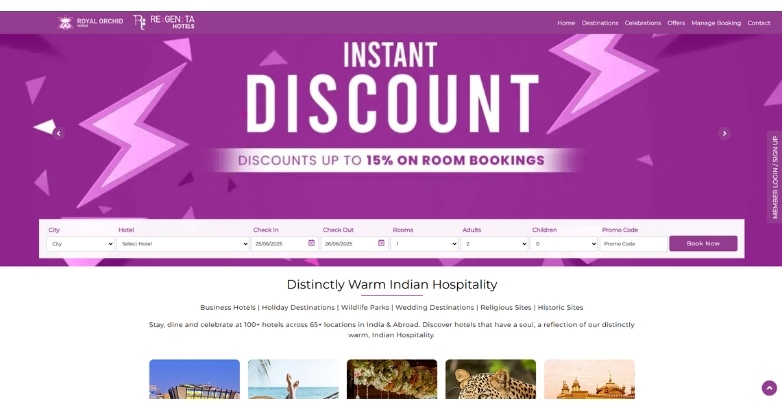
Objective: Drive direct bookings and boost online presence.
The Royal Orchid Hotel set a goal to grow direct bookings by 20% within six months.
With a $10,000 monthly PPC budget, the campaign focused on high-intent keywords like “luxury hotel in New York City.” Engaging ads and optimized landing pages were developed.
Once the campaign launched and was refined, direct bookings rose by 25%, the CTR reached 8.5%, and the conversion rate hit 12%.
This effort successfully increased brand awareness and search visibility, proving the impact of targeted hotel advertising.
2. Four Seasons Hotel
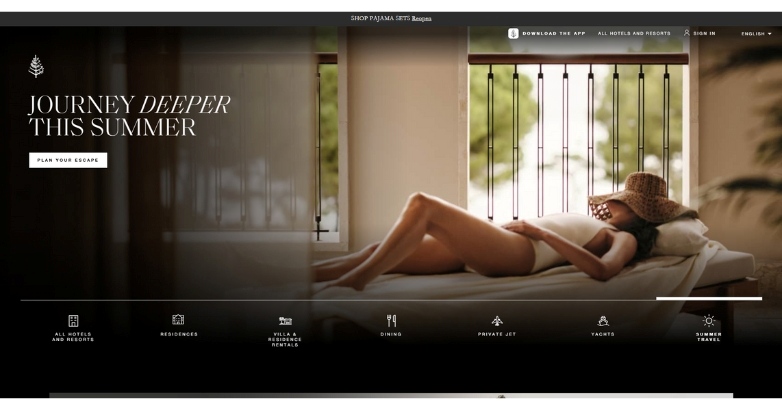
Objective: Increase Bali bookings among value-focused luxury travelers
To spark demand during Bali’s shoulder season, Four Seasons launched a PPC strategy aimed at budget-minded luxury guests.
The campaign used paid search and social media ads to highlight the resort’s oceanfront setting, private plunge pools, and top-tier spa offerings.
A tailored landing page with time-sensitive offers and authentic testimonials helped drive action.
Results included a 40% jump in CTR, 25% lift in conversions, 30% rise in bookings, and a 20% revenue gain during the slower season.
This focused strategy boosted visibility and delivered strong booking and revenue performance.
3. Mandarin Oriental
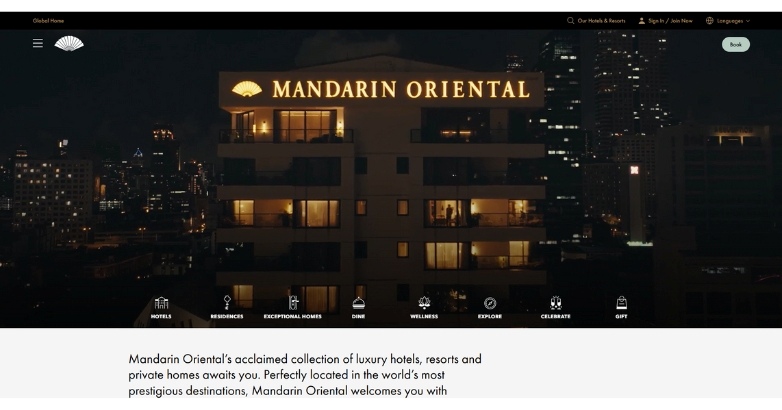
Objective: Drive direct bookings and strengthen digital reach in New York
Mandarin Oriental launched a refined PPC campaign to grow direct bookings and build online visibility. Using high-intent keywords like “luxury hotel New York” and “5-star hotel NYC,” it targeted affluent travelers seeking exceptional experiences.
The strategy featured a focused landing page with striking visuals, real guest reviews, and limited-time offers. Geo-targeting reached high-value markets including Los Angeles, London, and Tokyo.
Results included:
- 35% rise in CTR
- 28% increase in conversions
- 30% boost in direct bookings
- 22% revenue growth
This well-structured effort drove strong performance and highlighted the impact of targeted PPC.
FAQs
I. What is the best search engine for hotels?
Google. It owns about 90 % of global search traffic, and its Hotel Ads place live rates, photos, and reviews right above organic results.
II. How to do SEO for a hotel?
Start with a fast, mobile-friendly site. Add unique room and location keywords in titles, headings, and alt tags. Claim and optimize your Google Business Profile. Earn backlinks from local guides and tourism sites. Publish fresh articles answering travel questions.
III. How do I promote my hotel on Google?
Activate Google Hotel Ads through your booking engine. Run targeted Search and Display campaigns for branded and location keywords. Keep your Google Business Profile updated with rates, photos, and reviews. Encourage guests to leave reviews to lift visibility.
Elevate Your Hospitality Brand Today
Schedule Your Free Consultation
Seeking to elevate your business? Let Mediaboom guide you. Secure your exclusive, free consultation with our digital marketing experts today.
Harness the Power of Hotel Search Engine Marketing with Our Expert Team
In 2026, the hotel industry is more competitive than ever.
SEM puts your property in front of high-intent guests the moment they’re ready to book, driving instant visibility, stronger local presence, and higher conversions through optimized landing pages.
Partner with an expert team like Mediaboom, a hotel marketing agency that understands the nuances of SEM for hospitality, to design, manage, and optimize your hotel SEM campaigns. Claim the top slot in search results today and ensure your property is the first choice for travelers searching now.
By: Frank DePino
Frank DePino is the Principal and Founder of Mediaboom, a top hotel marketing agency partnering with leading hotel and hospitality brands. With 30+ years of experience, he has led strategic digital initiatives for names including Four Seasons, Ritz-Carlton, JW Marriott, Millennium Partners, and Guardian Jet. Frank helps hospitality businesses strengthen brand presence, drive qualified leads, and elevate guest experiences through website design, SEO, content marketing, and paid media. Under his leadership, Mediaboom is a trusted partner for brands pursuing measurable digital growth in a competitive hospitality landscape.