Hospitality Marketing – 10 Strategies to Attract More Guests

By: Frank DePino | September 8, 2026


Loading the Elevenlabs Text to Speech AudioNative Player...
Hospitality marketing is the process of presenting and promoting a hotel, resort, restaurant, venue, or travel experience to the people most likely to book it. It connects a clear market position with search, advertising, content, social media, email, reviews, and the guest experience.
The goal is to attract suitable guests, convert demand into revenue, and encourage repeat business.
Key takeaways:
- Start with the property’s commercial needs, audience, and market position.
- Treat the website, booking engine, listings, and reviews as parts of one marketing system.
- Match campaigns to a trip purpose, booking stage, and conversion action.
- Measure bookings, qualified inquiries, acquisition cost, and revenue instead of stopping at clicks.
What Is Hospitality Marketing?
Hospitality marketing is how a hospitality business attracts attention, earns trust, generates bookings or inquiries, and maintains relationships with guests.
It covers brand positioning, audience research, pricing communication, distribution, digital campaigns, partnerships, reputation, and retention.
Marketing in the hospitality industry is different from marketing a physical product. A room, table, event space, or tour is time-sensitive inventory. If tonight’s room is empty, that revenue cannot be recovered tomorrow.
The guest also cannot fully judge the experience before buying it, so images, reviews, policies, service details, and brand credibility carry unusual weight.
Effective hospitality marketing answers four questions:
- Who is the right guest?
- Why should that guest choose this property or experience?
- Where and when can the brand reach that person?
- What information will help the person book with confidence?
Hospitality marketing vs. tourism marketing
Hospitality and tourism overlap, but they are not identical. Hospitality marketing usually promotes a particular place to stay, eat, meet, or relax.
Tourism marketing promotes a destination and the wider reasons to visit it, including attractions, culture, transportation, events, and experiences.
Tourism and hospitality marketing work best together. A resort may sell its rooms and amenities, for example, while also building demand around nearby beaches, seasonal events, and local activities.
What unites marketing for hospitality and tourism is the need to sell an experience that begins long before arrival.
What Is the Importance of Hospitality Marketing?
The importance of hospitality marketing comes from its ability to turn changing travel demand into profitable bookings.
It helps a property reach the right audience, communicate its value, balance its booking sources, and build relationships that continue after a stay.
Hospitality businesses face seasonal demand, limited inventory, intense comparison, and high acquisition costs. A clear marketing system helps them:
- Generate demand for need periods and underused services
- Distinguish the property beyond price and location
- Support direct, third-party, dining, spa, event, and package revenue
- Build trust through accurate information and recent guest feedback
- Learn which audiences and offers produce the strongest returns
A guest may see a destination video, compare properties on an OTA, check reviews, visit the hotel’s website, and return through an email or ad. Connected marketing keeps the property recognizable throughout that decision.
Download Our FREE Guide
Outrank OTAs & Drive Direct Bookings With Our Hospitality Digital Marketing Guide
Learn how leading hotels increase website traffic, reduce OTA commissions, and convert more guests with targeted digital marketing strategies.
What Are the 7 Ps of Hospitality Marketing?
The 7 Ps help hospitality teams examine the full guest offer: Product, Price, Place, Promotion, People, Process, and Physical Evidence.
| Element | What it means in hospitality | Questions to ask |
| Product | The complete experience, including rooms, food, amenities, events, service, and location | Which guest need does the experience meet? What makes it distinct? |
| Price | Rates, packages, restrictions, add-ons, and perceived value | Does the price fit the property’s position and current demand? Is the value clear? |
| Place | Where the guest discovers and books, such as the direct website, OTAs, travel advisors, and metasearch | Are the right guests able to find and book the offer easily? |
| Promotion | Search, content, email, social media, public relations, partnerships, and paid campaigns | Which message and channel fit each stage of the booking journey? |
| People | Staff, sales teams, partners, creators, and guests who shape the experience | Does the human experience support the promise made in marketing? |
| Process | Booking, pre-arrival communication, check-in, service delivery, complaint handling, and follow-up | Where does friction or uncertainty cause lost bookings or poor stays? |
| Physical Evidence | Photography, design, cleanliness, signage, menus, amenities, reviews, and other proof of quality | What visible evidence helps the guest trust the promise? |
The elements must support one another. A luxury message will fail if booking is difficult, photography is dated, or reviews describe inconsistent service.
How Do You Build a Hospitality Marketing Strategy?
A hospitality marketing strategy defines the goal, priority audiences, market position, channel roles, budget, offers, and measures of success.
Set goals tied to business needs
Replace “get more awareness” with a measurable need, such as increasing midweek occupancy, generating wedding inquiries, growing direct revenue, or filling restaurant covers on slower nights. Give the goal a baseline, target, deadline, and acceptable acquisition cost.
Define the right guest segments
Segment guests by trip purpose, party type, origin market, booking window, price sensitivity, and desired experience. A coastal resort might target families during school breaks, couples for shoulder-season weekends, and remote workers for longer midweek stays.
Clarify the property’s market position
Positioning explains why a suitable guest should choose the property over realistic alternatives. “Luxury hotel with excellent service” is generic. “A quiet waterfront base for couples, within walking distance of the historic district” guides imagery, copy, packages, and proof.
Give every channel a specific role
Give every channel a job. Social media may introduce the experience, search may capture active demand, the website may convert it, email may bring guests back, and reviews may reduce hesitation. Record the audience, message, offer, landing page, conversion action, and KPI for each.
Which Hospitality Marketing Strategies Drive Results?
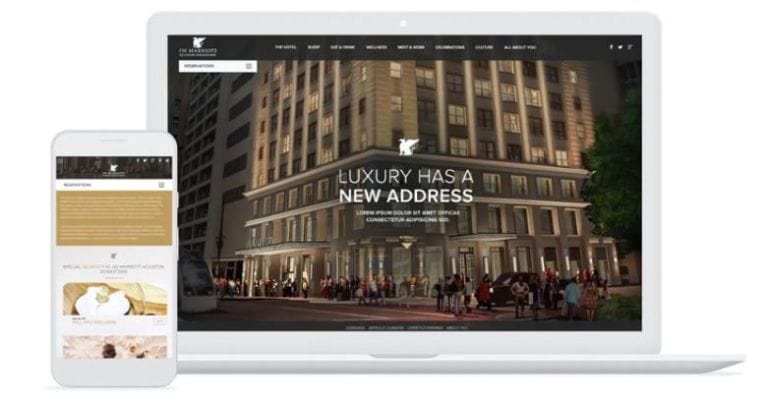
The best hospitality marketing strategies cover the full journey from inspiration to repeat booking. The following tactics are designed to work as one connected system.
1. Turn the website into a direct-booking tool
A hospitality website should quickly answer the questions that determine whether a guest will book.
Give visitors:
- A visible availability or reservation action
- Accurate room types, occupancy limits, bedding, amenities, and policies
- Original photography that shows scale, views, bathrooms, and shared areas
- Transparent information about fees, parking, accessibility, and cancellation
- Location context, including distances to major demand drivers
- A fast path from landing page to confirmed booking
Expedia Group reports that 59% of hotel guests book through a mobile website or app. Test date selection, rate comparison, forms, payment, and confirmation on mobile.
Restaurant and venue pages should provide menus, capacity, floor plans, event photographs, packages, and a short inquiry form.
2. Build visibility across search, maps, and travel discovery
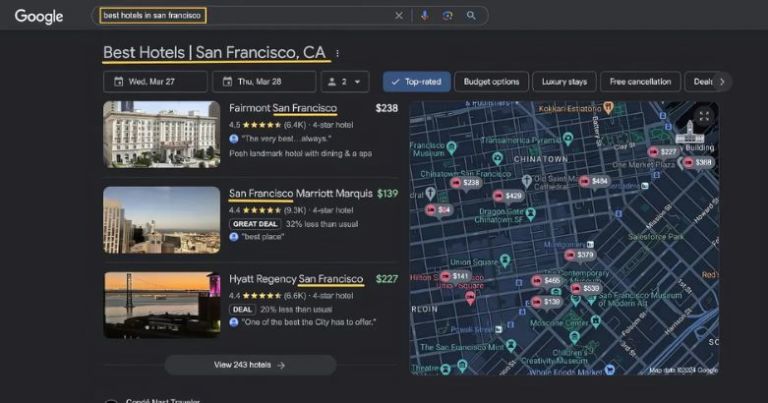
Search visibility should cover property-led and destination-led demand, including needs such as “family resort near Naples,” “hotel near convention center,” or “wedding venue for 150 guests.”
Build pages around valuable search intent, including:
- Accommodation types and amenities
- Meetings, weddings, dining, spa, and other revenue centers
- Neighborhoods, attractions, venues, campuses, and airports
- Seasonal events and trip-planning questions
- Comparisons that guests genuinely make before booking
Keep the Google Business Profile and major listings current with accurate categories, contact details, booking links, hours, amenities, photos, and review responses.
Use clear headings, direct answers, named locations, structured data, original expertise, and reliable sources so search engines and AI assistants can understand the content.
3. Publish content for real trip-planning questions
Good content reduces uncertainty. Start with questions found in search data, sales calls, reviews, front-desk conversations, and booking behavior.
Useful formats include:
- Two-day and three-day itineraries
- Seasonal destination guides
- Guides to nearby venues, beaches, trails, museums, or campuses
- Event planning checklists and sample schedules
- Room, package, or neighborhood comparisons
- Transportation, parking, weather, and accessibility guides
- Answers to common booking and stay questions
Match the next action to intent. A destination guide can lead to relevant rooms and dates; a wedding guide should lead to capacity details, packages, and an inquiry form. Publish only topics that connect the audience, location, services, and revenue goals.
4. Run hospitality advertising by audience and intent
Hospitality advertising works best when campaigns reflect guest intent. Branded search captures high-intent demand, nonbranded search reaches people comparing options, metasearch appears near booking, and paid social introduces experiences earlier.
For each campaign:
- Choose one audience and booking needs.
- Match the message to the search or creative.
- Send traffic to the most relevant page, not automatically to the homepage.
- Track completed reservations, qualified calls, or sales inquiries.
- Compare revenue and acquisition cost by campaign, property, and stay date.
5. Use social media and guest content to inspire travel
Social media often creates demand before a guest chooses a destination or property. In Expedia Group’s survey of 11,000 consumers across 11 markets, more than 60% cited social media as a source of travel inspiration.
Show the experience rather than a sequence of room promotions. Short videos can feature arrival, a room walk-through, breakfast, a chef, an event transformation, or a local itinerary.
Guest-created content adds a viewpoint brand photography cannot replace. Request permission, credit the creator, and choose material that reflects the current experience. Track saves, shares, website sessions, assisted bookings, and creator-specific offer use, not only follower growth.
6. Use email and CRM data to bring guests back
Email connects hospitality brands with past guests, subscribers, abandoned bookers, event leads, and loyalty members. Its value comes from relevance, not volume.
Useful segments may include:
- First-time and repeat guests
- Leisure, business, group, wedding, and dining audiences
- Drive-market and fly-market travelers
- Families, couples, solo travelers, and groups
- Guests who used a specific service or booked a certain package
- High-value guests and people at risk of not returning
Match messages to the relationship stage. Pre-arrival emails can help guests plan and add services, post-stay messages can request feedback, and seasonal messages can present a relevant reason to return. Use consent-based data and align offers with current rates and availability.
7. Make reviews part of the marketing system
Reviews affect visibility, trust, pricing power, and conversion. Expedia Group’s research found that 76% of surveyed consumers would pay more for a hotel with better customer reviews.
Request honest feedback after the experience and respond with specific, human replies. Review patterns should also shape operations and content. Repeated praise reveals credible selling points; repeated confusion about parking, fees, or room layout signals information that needs correction.
8. Form destination and local partnerships

Attractions, restaurants, event organizers, visitor bureaus, universities, wedding professionals, and local businesses can introduce a property to relevant audiences.
Partnerships might include:
- Joint packages with an attraction or experience provider
- Preferred rates for conference, wedding, or university guests
- Shared destination guides and itineraries
- Referral agreements with planners and travel advisors
- Local products or experiences included in a stay
- Cooperative campaigns around seasonal events
This is where tourism and hospitality marketing become especially valuable together. The destination supplies the reason to travel, while the hospitality business gives the visitor a place to stay, dine, meet, or celebrate.
Define the audience, booking path, offer, owner, and referral tracking. Otherwise, the partnership may become little more than a logo exchange.
9. Increase occupancy with targeted offers
If the question is how to increase hotel occupancy rate, begin with the dates, room types, and segments where demand is weak. Blanket discounts can damage rate without creating loyal guests.
Better options include:
- Midweek packages built for remote workers, business travelers, or retirees
- Stay-and-experience offers with local partners
- Longer-stay benefits for selected low-demand dates
- Small-group, retreat, or meeting packages
- Advance-purchase offers for predictable need periods
- Value-added offers with breakfast, parking, spa credit, or late checkout
- Campaigns aimed at nearby drive markets when booking windows are short
Use booking pace, local events, search demand, historical performance, and availability to decide when an offer is needed. Track average daily rate, revenue per available room, acquisition cost, and guest value alongside occupancy.
10. Personalize messages by trip purpose and booking stage
Personalization begins by showing relevant information to meaningful audience groups.
A family researching a summer stay may need connecting-room details, pool rules, breakfast options, and nearby activities.
A corporate planner needs capacity, technology, catering, availability, and response time.
A previous spa guest may respond to a wellness package, while a wedding guest may be a strong candidate for an anniversary offer.
Use first-party data, page behavior, stay history, and stated preferences carefully. Start with a few high-value segments and compare completed bookings or inquiries. Collect only the information the business needs and follow applicable privacy rules.
How Do You Measure Hospitality Marketing Performance?
Measure performance from initial demand through revenue and retention. Choose KPIs based on each channel’s job.
| Stage | Useful KPIs | What they reveal |
| Awareness | Qualified reach, nonbranded search visibility, video views, new website users | Whether the brand is reaching suitable new audiences |
| Consideration | Engaged visits, room-page views, booking-engine starts, email sign-ups, sales inquiries | Whether people are seriously evaluating the offer |
| Conversion | Completed bookings, booking conversion rate, qualified leads, cost per acquisition, direct revenue | Whether marketing produces business results efficiently |
| Property performance | Occupancy, average daily rate, revenue per available room, booking pace | Whether demand is improving for the intended dates and inventory |
| Retention | Repeat booking rate, CRM revenue, guest value, review volume and sentiment | Whether the experience creates future demand |
Agree on one source of truth for bookings and revenue. Connect the booking engine, analytics, CRM, calls, and inquiries where possible, then test every major conversion action.
Review results by segment, channel, stay date, room type, and booking window. A campaign can appear successful while filling nights that would have sold without it.
What Should a 90-Day Hospitality Marketing Plan Include?

A focused 90-day plan can fix the foundation before campaign spending grows.
Days 1 to 30: Diagnose and prioritize
- Set goals for specific dates, audiences, and revenue outcomes.
- Review positioning, competitors, guest feedback, and booking data.
- Test the website and booking path on mobile and desktop.
- Check listings and confirm that bookings, calls, forms, and revenue are tracked.
Days 31 to 60: Build the highest-value assets
- Improve the pages tied most closely to bookings or inquiries.
- Update weak photography or video.
- Publish content for high-value trip-planning questions.
- Segment email audiences and prepare campaigns for current need periods.
Days 61 to 90: Launch, test, and refine
- Start a small number of focused search, metasearch, social, or email campaigns.
- Test one major variable at a time, such as the offer, audience, message, or landing page.
- Compare completed bookings, revenue, and acquisition cost.
- Move budget toward the strongest combinations and stop weak campaigns.
- Record lessons and set the next quarterly priorities.
Hospitality Marketing FAQs
Which marketing channels work best for hotels?
Search, maps, metasearch, OTAs, paid media, social media, email, and partnerships can all work. The right mix depends on the hotel’s audience, location, booking window, brand strength, and need periods. Give each channel a defined purpose and compare results using completed bookings and revenue.
How can a hotel market itself during the low season?
Identify guest segments with a reason to travel during that period, then package the stay around their needs. Local events, remote-work stays, wellness weekends, small meetings, drive-market breaks, and value-added packages can build demand without relying on a permanent rate cut.
How much should a hotel spend on marketing?
There is no universal percentage that fits every property. Budget should reflect revenue goals, margins, current demand, brand maturity, channel costs, and the value of a booking. Start from an acceptable acquisition cost, fund the channels that can meet it, and adjust using confirmed revenue.
How often should a hospitality marketing strategy be reviewed?
Teams should monitor campaign and booking performance weekly, review channel and audience results monthly, and revisit the main strategy each quarter. Major demand changes, new competitors, property renovations, or changes in business goals may require an earlier review.
Can an independent hotel compete with large hotel brands?
Yes. An independent property can compete through a distinct position, strong local knowledge, original guest experiences, responsive service, useful destination content, and direct relationships with past guests. It does not need to match a large brand’s budget across every channel; it needs to win with the audiences and searches most relevant to its offer.
Elevate Your Hospitality Brand Today
Schedule Your Free Consultation
Seeking to elevate your business? Let Mediaboom guide you. Secure your exclusive, free consultation with our digital marketing experts today.
Build a Connected Hospitality Marketing System
Hospitality marketing performs best when the offer, website, search presence, advertising, content, reviews, email, and guest experience communicate the same reason to choose the brand.
Start with a defined commercial need and audience. Fix the booking foundation, select the channels suited to the journey, and judge them by the revenue and guest relationships they produce.
Mediaboom helps hotels, resorts, restaurants, and other hospitality brands connect strategy, content, web design, search, paid media, and measurement. Contact Mediaboom to discuss a hospitality marketing program built around your property, audience, and revenue goals.
WHAT OUR CLIENTS SAY
By: Frank DePino
Frank DePino is the Principal and Founder of Mediaboom, a top hotel marketing agency partnering with leading hotel and hospitality brands. With 30+ years of experience, he has led strategic digital initiatives for names including Four Seasons, Ritz-Carlton, JW Marriott, Millennium Partners, and Guardian Jet. Frank helps hospitality businesses strengthen brand presence, drive qualified leads, and elevate guest experiences through website design, SEO, content marketing, and paid media. Under his leadership, Mediaboom is a trusted partner for brands pursuing measurable digital growth in a competitive hospitality landscape.